
This is my take on the manner in which aforementioned question could be attempted.
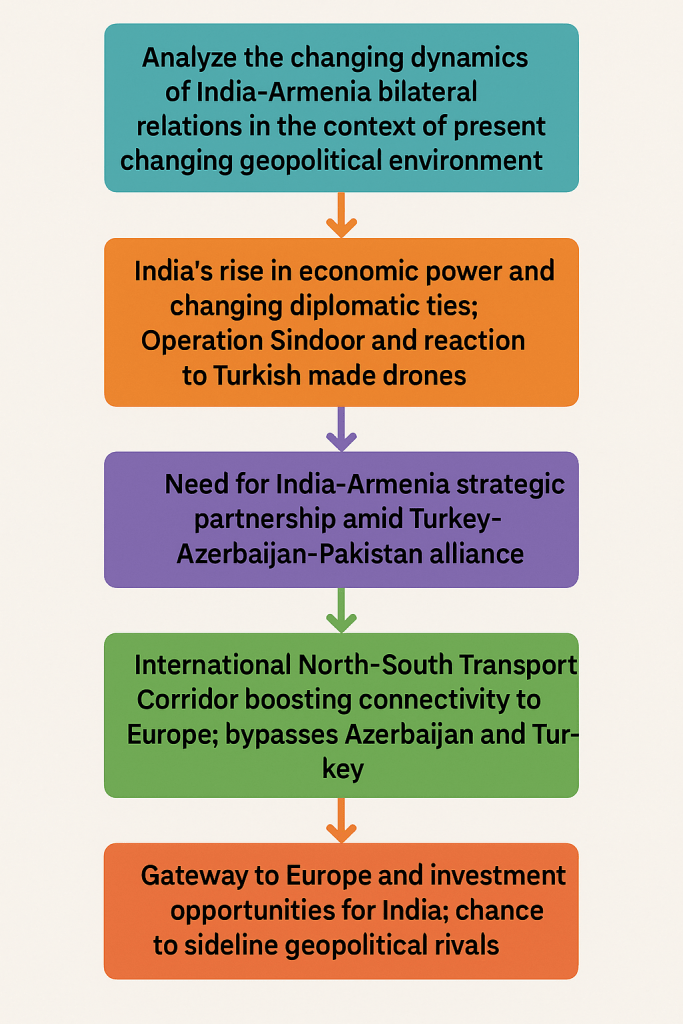
Answer : This past couple of decades have seen not only rise in the economic power and strength of India on world stage, but also the changing dynamics of ties and the concurrent support at the diplomatic level. The Pahalgam massacre and the consequent action by India in form of Operation Sindoor, followed by global reaction involving various countries, has indeed thrown light on friends and foes when it comes to India. During Operation Sindoor , discovery of Turkish made drones ,has again put spotlight on the fact that India has not only been repeatedly attacked by it’s neighbour, Pakistan, but also continuously buffeted by the attacks and political jibes thrown at it from countries that support Pakistan. One such country of course happens to be Turkey. While strengthening relations with countries that have hostile or not so friendly relations with Turkey would be an obvious choice, however, at the global level harnessing the geo-economic capital with these countries through diplomatic channels has its own wide ranging benefits.
Precisely for this aforementioned reason ,the relationship with Armenia has to transcend from being mere friendly allies to strategic partners with mutually shared values along with ideological leanings should act the the foundational stones for this partnership. The visit of H.E. Ararat Mirzoyan, Minister of Foreign Affairs of the Republic of Armenia to India (March 09-11, 2025) hold significant importance.As per Ministry Of External Affairs press briefing (mea.gov.in) discussion were held that ranged “in the areas of political exchanges, trade, economic, connectivity, education, culture, and people-to-people contacts. They agreed to explore cooperation in digital technologies, and pharmaceuticals. The discussions also focused on multilateral cooperation at the UN and other fora. The Ministers also exchanged views on regional and global matters of shared interest.” Additionally, two MoUs were signed namely, in field of cooperation in the field of regulation of medical products between CDSCO, India and CDMTE, Armenia ,and in field of cooperation between Sushma Swaraj Institute of Foreign Service and Diplomatic School of the Ministry of Foreign Affairs of Armenia.It is to be noted that “India-Armenia-Iran trilateral consultations were held in Yerevan in April 2023. Indian delegation was led by JS (PAI) Shri. J.P. Singh” and first “India-Armenia Policy Planning Dialogue was conducted in Yerevan in July 2023. The Indian delegation was led by JS (PP&R), Dr. Sumit Seth.” (mea.gov.in)
Let’s look at a deeper understanding of possible fields of cooperation between India and Armenia. If from the perspective of India, countering Pakistan and the countries in its support such as Turkey and Azerbaijan at global level( along with weaponry defense support from Turkey to Pakistan), ties with Armenia hold importance, then from the perspective of Armenia in order to counterbalance Azerbaijan and Turkey that have been exerting quite enormous pressure on Armenia, strategic partnership with India is of great significance. Defense relationship in form of arms procurement (Akash-1S air defense system , the Pinaka multi-barrel rocket launcher , artillery, and radar systems) from India has turned out to be mutually beneficial.
Yet, as mentioned earlier, the relationship between India and Armenia must been seen from the perspective of “looking above the horizon”, as one would say, gathering foresight into the possible benefits India and Armenia would reap in the next ten to fifteen years.
The relationship between India and Armenia in present unstable geopolitical environment has indeed shown signs of transmogrification from mere allies to strategic partners pointing to multi-pronged strategy to harness multi-dimensional engagement and cooperation. This is where the topic of interest in form of International North–South Transport Corridor (INSTC) holds significant geopolitical and geoeconomic value—especially for India, with Armenia’s uniquely significant position in an alternate INSTC route within the corridor can be a fame changer for both India and Armenia.
NOTE: While INSTC CORRIDOR is a separate subject in itself , extremely complex within the ever changing geopolitical and geo-economic environment, the answer will focus on an alternative route within the INSTC Corridor that involves Armenia and India as part of the route which is incredibly important for the discussion regarding India – Armenia bilateral relations.
(Let’s get back to the answer) With the unstable , certainly hostile, relations with Azerbaijan and Turkey in the backdrop of Pahalgam massacre and consequent Operation Sindoor (though the relationship was already on the road to getting sour in last decade or so), Armenia provides a unique opportunity within the International North–South Transport Corridor (INSTC) carrying immense strategic and economic importance, particularly from India’s perspective.
Indeed , it is possible gateway for India to European markets, bypassing Azerbaijan and Turkey, striking them to the side, while building a more concrete relationship with Armenia . The trilateral format within which Iran, India, and Armenia initiated a trilateral political dialogue in Yerevan, focusing on economic and regional connectivity in April, 2023 , is of great importance.For India, this strategy ensures access to vital trade and transport routes connecting it with Central Asia, Russia, and Europe through Armenia, thereby reinforcing the International North-South Transport Corridor (INSTC). It also acts as a strategic countermeasure against the growing influence of Turkey and Pakistan in the region, while providing a forward position to balance China’s presence across the Turkic arc of Central Asia. Additionally, it supports India’s ambitions to expand its defense exports and deepen its diplomatic engagement in the broader region.
( Let’s focus on the Armenia’s spot on the route and how lucrative it is in terms of freight logistics and bypassing the present geopolitical hostile forces of Azerbaijan and Turkey buffeting India. )
When Armenia is placed on INSTC ROUTE within the corridor, it will begin from Mumbai (India) to Chabahar (Iran ) as sea route, followed by movement of freight from Chabahar or Bandar Abbas (both in Iran) to Norduz (in Iran) and cross into Armenia. This will be a road and / or rail route. The movement by road / rail would enter through Meghri(Armenia), pass Yerevan followed by Gyumri and then exits Armenia and enters Georgia. In Georgia, there are two possible routes to be charted . One is movement to Poti or Batumi (Black Sea ports in Georgia). Second is movement via land route to Russia through Upper Lars border crossing. Either way, lastly the cargo movement would enter Russia the Black Sea to Europe or via road into Russia (Vladikavkaz, Moscow).
Significance of the aforementioned alternative route when Armenia is included is incredibly interesting from perspective of India. It serves as a multi-pronged approach when it comes to reaping benefits and bypassing the hostile forces. This route bypasses Pakistan, Turkey and Azerbaijan. Harnessing the Chabahar Port facilities is of great importance as May 13, 2024, previous Union Shipping Minister, Sarbananda Sonowal in his visit to Iran, signed a historic and landmark 10-year agreement between India Ports Global Ltd and Iran’s Maritime Organisation.As part of the deal, India will invest approximately $120 million to enhance and manage operations at the Shahid Beheshti terminal in Chabahar Port. Additionally, a credit line of $250 million will be extended for broader infrastructure development in the region. As mentioned earlier, this route within the corridor opens gateway to Europe through Central Asia,Southern Caucasus and Eastern Europe – access of Black Sea ports opens gateway to Southeastern and Central Europe. It provides excellent wide opportunities for Indian companies to invest in fields of logistics, construction, and infrastructure in Armenia and Georgia. Additionally, from the perspective of freight logistics data, integrating Armenia into the INSTC network allows freight to bypass traditional sea routes like the Suez Canal. This overland corridor can cut transportation time between India and Europe by up to 40%, ensuring faster delivery of goods.The combined land–sea pathway through Iran, Armenia, and Georgia enables more direct and efficient cargo movement. By reducing the need for transshipment and minimizing logistical handling, it helps drive down overall freight costs for exporters and importers alike.
(Let’s conclude the answer)
It can be concluded that beyond immediate defense procurement deals, Armenia provides a way to Europe for one of the fastest growing economies of the world, that is India. While sidelining Pakistan, Turkey and Azerbaijan, the possible route on INSTC CORRIDOR ( provided infrastructural bottlenecks are swiftly dealt with) provides not just Markey for Indian goods and services but ever burgeoning field for investments , along with cooperation on basis of shared values and ideological leanings.
Sources
mea.gov.in
moderndiplomacy.eu
The Hindu
 Simplified Learning UPSC by Tanu
Leave a comment