

Prime Minister of India, Narendra Modi, has been invited to G7 summit in Canada at the behest of the Canadian Prime Minister, Mark Carney. It has to be noted that though India is not a member of G7 , however India has been invited since 2019,pointing the ever growing economic power and influence of the largest democracy of the world.

Canada’s Stance:
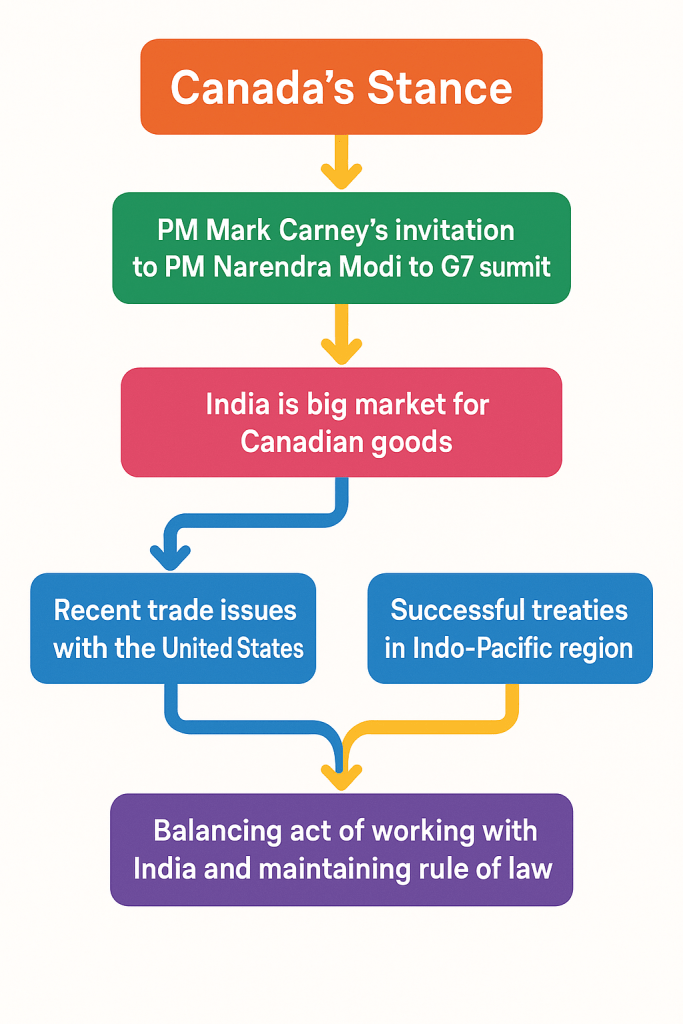
In the ever changing world political environment, Canada’s necessity to maintain rule of law RCMP investigation into murder of Nijjar has to balanced with equally important madate of fulfilling the responsibility of providing economic security and prosperity to the Canadians. In this regard, PM Mark Carney’s invitation to PM Narendra Modi to G7 summit holds great significance. India is big market for Canadians goods. While United States of America is the biggest trade partner for Canada, the recent trade issues between US and Canada, has indeed put a spotlight on possible reinvigorating of India – Canada relations. Additionally, Canada cannot have successful treaties in Indo-Pacific region by not including India. It has to be noted that while RCMP, Canadian Security Force , has put out the view it has legitimate evidence regarding people linked with Indian government, of being involved in plot to murder a Canada citizen on Canadian soil, India has vociferously denied this accusation. This point will be discussed further in the next section.
For now it , let’s get back to the pulls and pressures exerted on the Mark Carney’s government. In the present time of global realignment causes by changed stance of US , relationships with India , however strained they are, present an opportunity to Canada . For Canada cooperation with other liberal democracies could produce trade partners and reliable allies, especially when relations with US and China haven’t been easy either. So from perspective of Canada, maintaining a balancing act of working with the largest, most vibrant democracy, with burgeoning market opportunities, and at the same time maintaining rule of law is important.
India’s Stance:
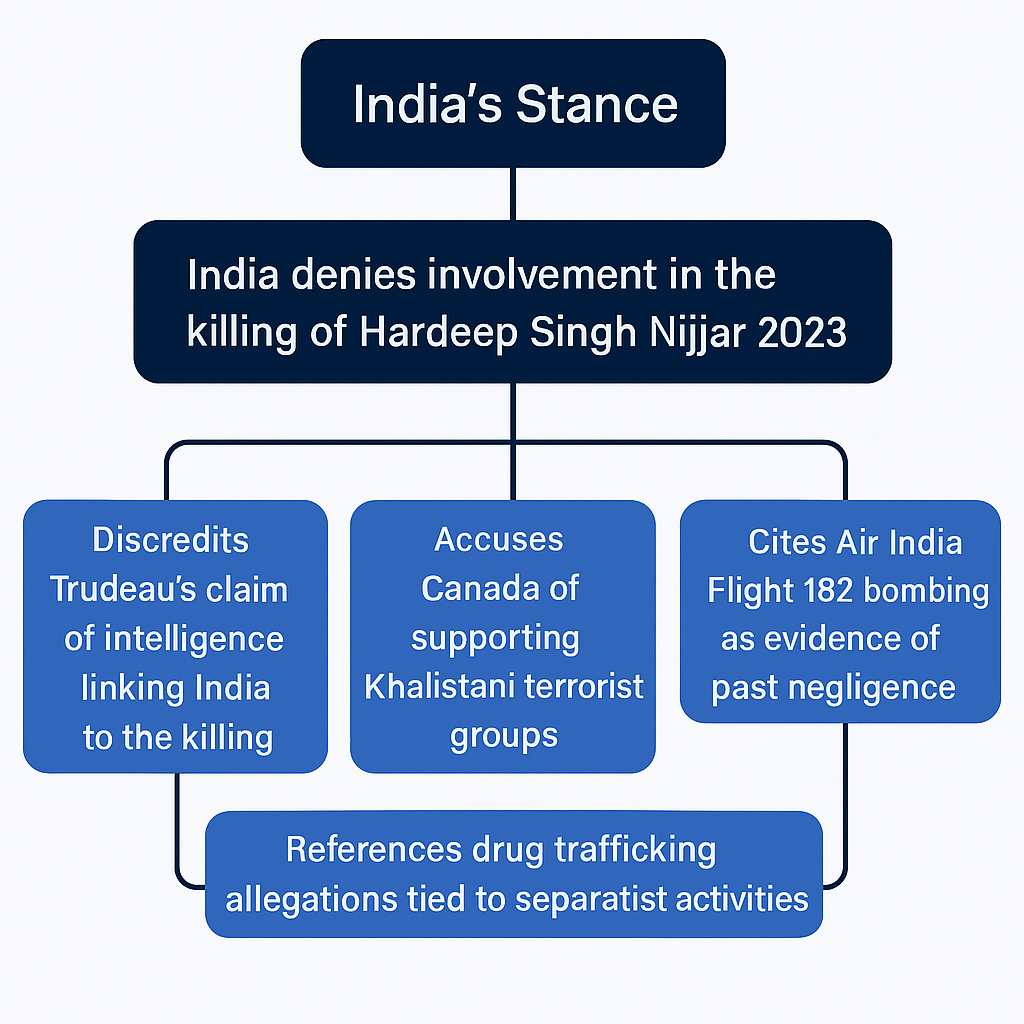
Let’s now focus on India’s stance regarding the strained relationship with Canada over killing of Khalistani separatist leader Hardeep Singh Nijjar in 2023. India has vociferously denied any role in the killing of Hardeep Singh Nijjar. Former Prime Minister of Canada, Justin Trudeau, testified before the Public Inquiry into Foreign Interference in Federal Electoral Processes and Democratic Institutions, wherein he mentioned that “there was intelligence from Canada and possibly from Five Eyes allies that made it fairly clear,that India was involved in this…Agents of government of India were involved in the killing of a Canadian on Canadian soil”. However, it is to be noted that Former Prime Minister of Canada, Justin Trudeau, had also mentioned that the intelligence was only “hard evidentiary proof”.
This is where the irony of ironies lies. From perspective of India, it transnational crime and international repression that Canada had accused India of, India has accused Canada of doing the same. Canada has been a fertile ground for Khalistani separatist terrorist groups such as International Sikh Youth Federation (ISYF) and Babbar Khalsa International (BKI). Until 9/11, the bombing of Air India flight 182 in 1985 that claimed lives of 329 people was the biggest terrorist attack in aviation sector. As per the answer to the RAJYA SABHAUNSTARRED QUESTION NO-405 which was answered on 06/02/2025, the Minister of State in the Ministry of External Affairs (Shri Kirti Vardhan Singh), “On 16 June 2010, nearly 25 years after the bombing, the Government of Canada received the final report of the Commission of Inquiry titled, ‘Air India Flight 182: A Canadian Tragedy’ which was a damning indictment of actions taken before and after the tragedy. The Commission identified numerous mistakes that were committed around the time of the bombing, including as regards the treatment of the victims’ families.”
“Some of the findings of the Commission, inter alia are:
• Canadian Government agencies were in possession of significant pieces of information that taken together would have led to the conclusion that Flight AI-182 was at high risk of being bombed by known pro-Khalistani terrorists in June 1985.
• Canadian Government agencies failed to appreciate the nature and seriousness of the threat of pro-Khalistani extremism.” (mea.gov.in)
Unfortunately , pace of Khalistani separatist movement has not slowed down. Hardeep Singh Nijjar was a supporter of Khalistani movement. He was a Babbar Khalsa International operative and later chief of Khalistani Tiger Force. Several sources have pointed out that this could be case of gang war rivalry.
Additionally, the Project Pelican undertaken by Canada’s Peel Regional Police , seized over 450 kilograms of cocaine worth $48 million. Seven of nine people arrested are of Indian origin. Furthermore, many reports have suggested that money from such illegal activities was used for Khalistani separatist movement activities and referendums, thereby undertaking activities that involve Interference in working of democratic working of India and attacking sovereignty of India.
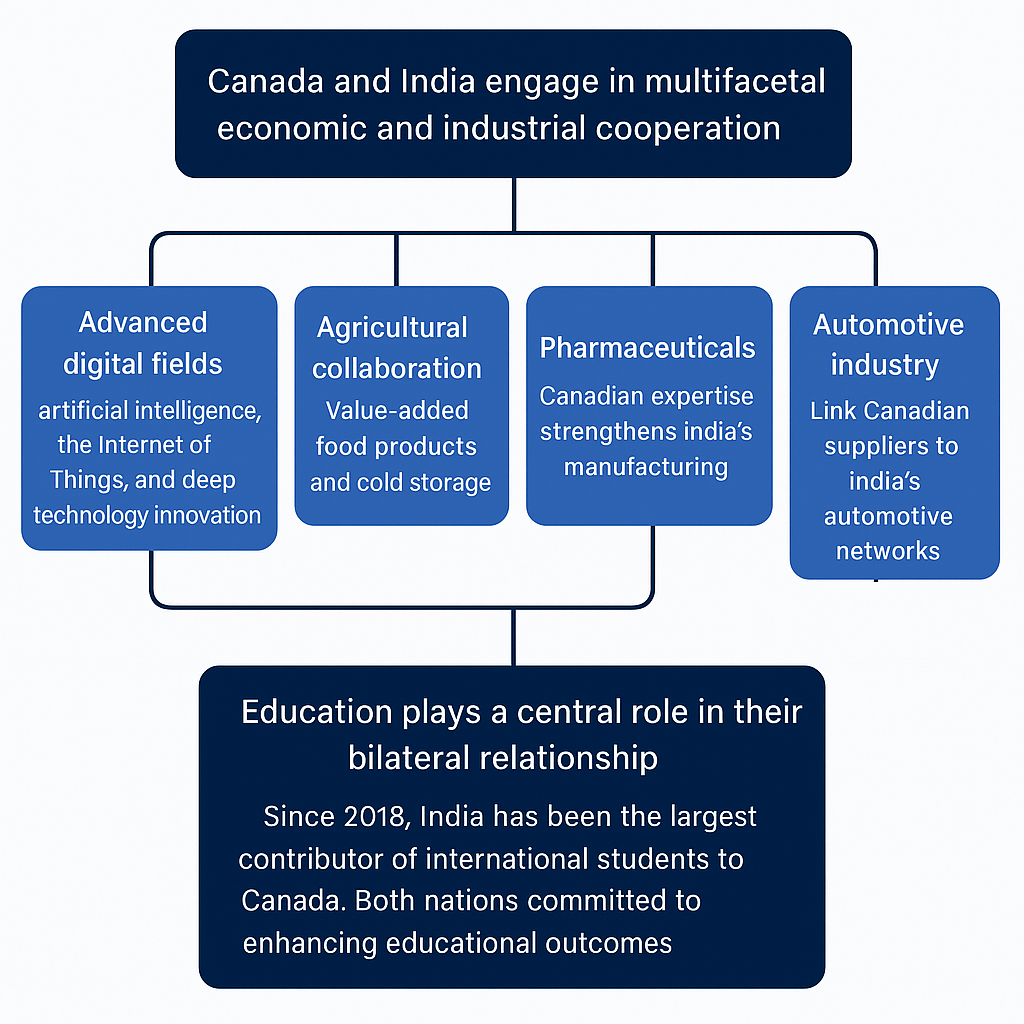
Let’s focus on fields of mutual interests between India and Canada :
Canada and India engage in multifaceted economic and industrial cooperation across both cutting-edge and established sectors. Key areas of partnership include:Advanced digital fields such as artificial intelligence, the Internet of Things, and deep technology innovation.Agricultural collaboration, focusing on value-added food products and enhancing supply chain systems like cold storage.Pharmaceuticals, where Canadian expertise contributes to the strength of India’s pharmaceutical manufacturing.Automotive industry, with efforts to link Canadian suppliers into India’s automotive production networks.Education plays a central role in their bilateral relationship. Since 2018, India has been the largest contributor of international students to Canada. Both nations are committed to enhancing educational outcomes through institutional cooperation and skills development initiatives.
At the end it can be said that the democratic pluralistic values shared by democracies of Canada and India can be harnessed for mutual benefit . It is important for Canada to address the Khalistani separatist terrorist infrastructure and movement in Canada. By doing so, Canada will find an ally and reliable trade parrner in liberal democracy of India.
Sources
pib.gov.in
mea.gov.in
international.gc.ca
The Hindu
 Simplified Learning UPSC by Tanu
Leave a comment